
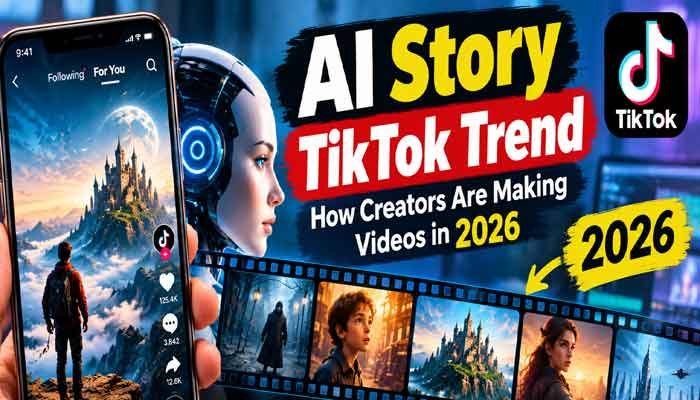
If you have been scrolling through TikTok recently, you may have noticed a growing type of content that looks more like a mini movie than a traditional short video. These videos use artificial intelligence to create characters, locations, cinematic scenes, narration, music and captions around a short story.
The AI Story TikTok Trend is becoming an interesting way for creators to turn simple ideas into short-form visual stories without needing a traditional camera setup, actors or expensive locations.
A creator can start with a story idea, turn it into a script, generate visuals, add an AI voice, edit the scenes and publish the final video as a vertical TikTok. The process still requires creativity and editing, but AI can reduce much of the production work.
In 2026, TikTok is also adding more AI-powered creation tools. TikTok introduced tools such as Smart Split and AI Outline to help creators with editing and content planning. Smart Split can turn longer videos into shorter clips, while AI Outline can help generate titles, hooks, hashtags and outlines from a prompt or searched topic.
The AI Story TikTok Trend is changing how creators create short-form storytelling videos in 2026.
Read Also This : 1980s AI Photo Trend: 25+ Prompts to Create Retro 80s Photos
Why Is the AI Story TikTok Trend Becoming Popular?
What Is the AI Story TikTok Trend?
The AI Story TikTok Trend refers to short-form videos where artificial intelligence is used to create or support different parts of the storytelling process.
A typical AI story video can include:
- An AI-written or human-written script
- AI-generated characters
- AI-generated images or video scenes
- AI voice narration
- Background music
- Sound effects
- On-screen captions
- Fast scene transitions
- A strong opening hook
The story itself can be fictional, emotional, mysterious, motivational, historical, humorous or fantasy-based.
For example, a creator could open a video with:
“Every night at exactly 3:17 AM, the old man received a phone call from a number that did not exist.”
The viewer then follows the mystery through a sequence of AI-generated scenes.
This combination of curiosity, visual storytelling and short-form video makes the format particularly suitable for TikTok.
Why Is the AI Story TikTok Trend Becoming Popular?
One of the biggest attractions is convenience.
Traditional video storytelling can require a camera, actors, locations, lighting, equipment, editing and narration. AI tools can reduce some of those production requirements and allow a creator to develop visual content from a written idea.
But convenience is only one part of the trend.
1. Stories Create Curiosity
A good story naturally makes viewers ask questions.
What happens next?
Who is the mysterious character?
Why did the event happen?
Will the main character escape?
What is the secret behind the situation?
These questions can encourage viewers to continue watching because they want to discover the answer.
2. Creators Can Work Without Showing Their Face
One major advantage of AI storytelling is that creators do not necessarily need to appear on camera.
A faceless creator can combine:
- A written story
- AI-generated visuals
- AI narration
- Music
- Captions
- Video editing
This makes storytelling accessible to people who prefer not to become an on-camera personality.
However, faceless content is not automatically successful. The story, pacing, visuals and editing still need to hold the viewer’s attention.
3. Visuals Can Be Designed Around the Story
AI-generated visuals give creators more freedom when developing fictional worlds.
A story can take place in:
- An abandoned city
- A futuristic world
- A magical kingdom
- A historical setting
- A mysterious forest
- A fictional planet
- An imaginary village
Instead of searching through stock footage for something that only partially matches the script, creators can develop visuals specifically for individual scenes.
4. Short Stories Fit TikTok’s Format
An AI story can easily be divided into several short scenes.
For example:
Scene 1: Introduce the mystery
Scene 2: Show the main character
Scene 3: Introduce the problem
Scene 4: Increase the tension
Scene 5: Reveal new information
Scene 6: Finish with a twist
This structure gives a simple idea a beginning, middle and ending while keeping the video moving.
How Creators Are Making AI Story TikTok Videos
Creating an AI story video may look complicated when you see the finished result, but the basic workflow is relatively straightforward.
Step 1: Start With a Story Idea
The first step should be the story rather than the image generator.
A strong idea usually creates curiosity immediately.
Some examples include:
- A mysterious package arrives at someone’s house
- A child discovers a hidden room
- A robot remembers someone from its past
- A traveler finds a village missing from every map
- A strange message appears every night
- An old photograph changes every morning
The strongest concepts normally contain a question, mystery or conflict.
Step 2: Write a Short Script
After choosing the idea, develop it into a short script.
The opening is particularly important for short-form content. Instead of spending several seconds explaining the background, creators can begin with the most interesting part of the story.
For example:
Weak opening:
“Today I am going to tell you about a man who lived in a small town.”
Stronger opening:
“Everyone in the town remembered him. The strange part was that he had never lived there.”
The second opening creates an immediate question and gives the viewer a reason to continue.
Step 3: Divide the Story Into Scenes
Once the script is ready, divide it into individual visual scenes.
Each scene can have its own prompt describing:
- Character
- Location
- Lighting
- Camera angle
- Clothing
- Facial expression
- Environment
- Mood
- Action
Character consistency is particularly important.
If the main character has black hair and a blue jacket in the first scene, those details should remain consistent throughout the video. Otherwise, the character may look different from one scene to another.
Step 4: Generate the Visuals
The next step is to create images or video clips for each scene.
The visuals should support the narration rather than simply act as decoration.
For example, if the narrator says that the character enters an abandoned house, the screen should show the character approaching or entering that house.
This creates a stronger connection between the narration and the visuals.
Step 5: Add AI Voice Narration
Many AI story videos use synthetic narration.
A good narration should sound natural and match the mood of the story.
For suspense content, pauses can help create tension. For emotional stories, slower delivery may work better.
The goal is not simply to generate a voice but to make the narration feel connected to the story.
Step 6: Add Captions
Captions are important because some people watch short videos without sound.
Instead of placing a large paragraph on every frame, creators can highlight important words and sentences.
Short captions can also make important moments easier to follow.
Step 7: Add Music and Sound Effects
Music can dramatically change the mood of a story.
A mystery story might use atmospheric background music, while an emotional story may use softer music.
Sound effects can also emphasize important moments such as:
- A door opening
- A phone ringing
- Footsteps
- A sudden reveal
- An explosion
- A character entering a room
The music should support the narration rather than overpower it.
Step 8: Edit the Final Vertical Video
TikTok is designed around vertical video, so the final story should be edited for a phone screen.
A finished video may include:
- Short scenes
- Voiceover
- Captions
- Background music
- Sound effects
- Zoom effects
- Transitions
- Visual changes
- Story reveals
The objective is to keep the story moving without making the video feel chaotic.
What Types of Stories Work With AI?
The AI Story TikTok Trend is not limited to one storytelling category. Creators can experiment with many different formats.
Mystery Stories
Mystery stories naturally create curiosity because viewers want to discover the answer.
A strange phone call, unexplained photograph or missing person can become the central idea of a short video.
Horror Stories
AI visuals can be useful for fictional horror because creators can create unusual environments, creatures and locations that may be difficult to film traditionally.
Emotional Stories
Stories about friendship, family, kindness, loss and unexpected reunions can also be adapted into short AI videos.
The visuals can help communicate emotions while the narration moves the story forward.
Historical Stories
AI visuals can recreate historical-looking environments and characters for storytelling.
However, creators should clearly distinguish fictional stories from genuine historical information. AI-generated visuals should not automatically be treated as evidence of real historical events.
Fantasy Stories
Fantasy is another natural fit for AI storytelling.
Creators can build stories around:
- Dragons
- Magical cities
- Ancient kingdoms
- Futuristic worlds
- Fictional creatures
- Imaginary planets
Moral Stories
Some creators use short stories to end with a lesson.
A simple structure can be:
Problem → Decision → Consequence → Lesson
This format can work well when the creator wants the video to leave viewers with a clear message.
Can You Make AI Story TikTok Videos Without Showing Your Face?
Yes.
A creator can produce a faceless storytelling video using a script, AI visuals, narration, music, captions and editing.
This is one reason the format is attractive to creators who want to experiment with TikTok without becoming the main visual subject of their videos.
But faceless content does not mean effortless content.
The creator still has to choose the idea, improve the script, control the pacing, select the visuals and decide how the story should make the viewer feel.
The technology can assist with production, but creative decisions still matter.
TikTok’s AI Tools for Creators
TikTok is also developing AI-powered tools that can help creators with different parts of the content creation process.
In October 2025, TikTok announced Smart Split, an AI-powered editing tool that can automatically clip, reframe, caption and transcribe longer content into shorter videos.
TikTok also introduced AI Outline, which can help creators structure content by generating video titles, hashtags, hooks and outlines from prompts or highly searched topics.
These tools show how AI is becoming part of the broader video-production workflow.
However, creators do not necessarily need to use every available AI feature. A simple workflow can be easier to manage than a complicated collection of tools.
The most important part remains the story.
Is AI-Generated Content Allowed on TikTok?
Creators should pay attention to TikTok’s current AI-content rules before publishing.
TikTok’s official guidance says AI-generated content can include images, video and audio generated or modified by artificial intelligence. TikTok also requires labeling for certain realistic AI-generated content and provides creator and automatic labeling options.
For example, TikTok explains that realistic AI-generated images, audio and video should be labeled according to its guidelines. Creators can disclose AI-generated content through the post settings, text, hashtags or description, depending on the situation.
Creators should therefore check TikTok’s latest AI-generated content requirements before publishing an AI story.
This is especially important when AI is used to create realistic people, events or situations because viewers should be able to understand the nature of the content.
AI Story TikTok Trend Still Needs Human Creativity
The biggest mistake would be assuming that AI automatically creates a good story.
AI can generate:
- Images
- Video
- Voice
- Ideas
- Scripts
- Captions
But those elements do not automatically create an engaging narrative.
Viewers can quickly become bored when every video uses the same voice, characters, music, visual style and predictable plot.
A better workflow is:
Human idea → AI assistance → Human editing → Final story
The creator remains responsible for the creative direction.
This is particularly important because storytelling is not only about producing visuals. It is about creating curiosity, emotion, tension and a satisfying ending.
How to Make an AI Story TikTok More Interesting
If you want to experiment with the AI Story TikTok Trend, focus on storytelling before complicated visual effects.
Start With a Strong Hook
The first sentence should make the viewer curious.
Instead of explaining everything immediately, introduce a question, mystery or unusual situation.
Keep One Main Story
Avoid trying to tell several unrelated stories in one short video.
One clear storyline is easier for viewers to follow.
Match Visuals With Narration
Every visual should have a reason to appear.
If the narrator is describing a character walking through a dark forest, the visual should support that moment.
Keep Character Details Consistent
Use consistent descriptions for clothing, hair, age, environment and other important visual characteristics.
Consistency makes AI-generated scenes feel more connected.
Don’t Overuse AI Effects
More effects do not necessarily make a video better.
Too many transitions, animations and visual effects can distract viewers from the actual story.
Give the Story an Ending
A strong opening needs a satisfying payoff.
The ending could include:
- A twist
- An emotional reveal
- A surprising discovery
- A lesson
- A final unanswered question
Develop a Recognizable Style
A consistent visual style, narrator, storytelling format or theme can make an account easier to recognize.
Over time, viewers may begin to associate that style with your content.
Will AI Story Videos Replace Traditional Creators?
AI is changing the way short-form videos can be produced, but storytelling still depends heavily on human creativity.
TikTok has also continued supporting creator-led storytelling. In June 2026, TikTok and Sundance Collab announced a micro-series writing program focused on short-form serialized storytelling and scriptwriting.
This points toward a future where AI can assist with production while creators continue to control the story, characters, pacing and creative direction.
The technology may make production faster, but it does not remove the need for a good idea.
Final Thoughts on the AI Story TikTok Trend
The AI Story TikTok Trend is more than simply generating pictures with an AI tool.
At its best, it combines a strong idea, a short script, compelling visuals, narration, music, captions and smart editing into a story that gives viewers a reason to keep watching.
Creators can use AI to make production faster, experiment with new visual styles and build faceless storytelling channels. At the same time, they still need to make creative decisions about the story and audience experience.
The most useful approach is to treat AI as a production assistant rather than the entire creative process.
Human idea → AI production → Human editing → Better story.
That is what makes the AI Story TikTok Trend interesting in 2026: the technology can create the scenes, but the creator still has to give the story a reason to exist.
The AI Story TikTok Trend shows how AI is changing the way short-form stories are created.